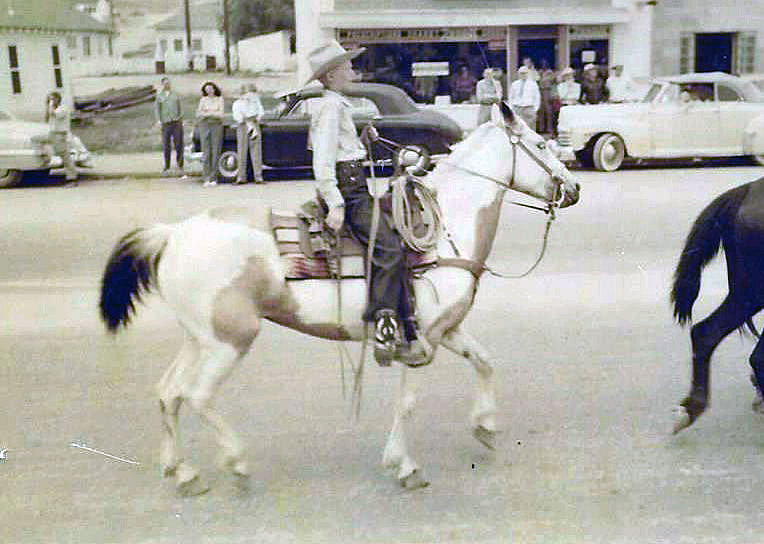
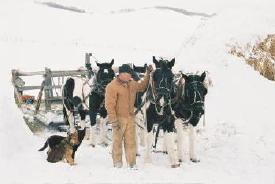
Joe on Melody

Crawford

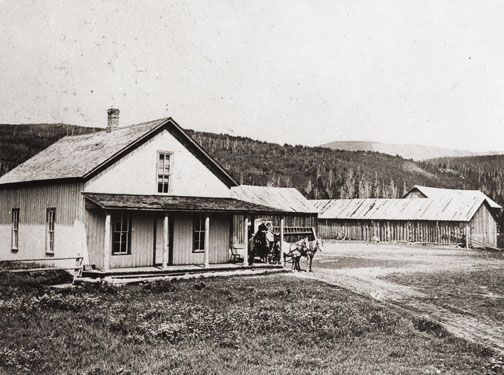
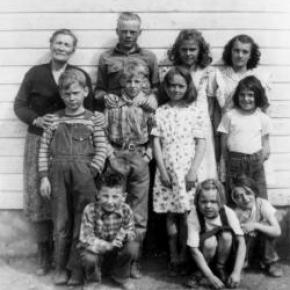
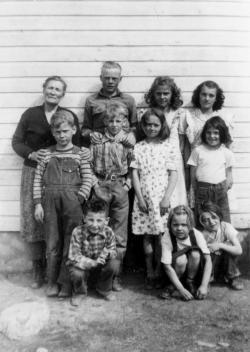
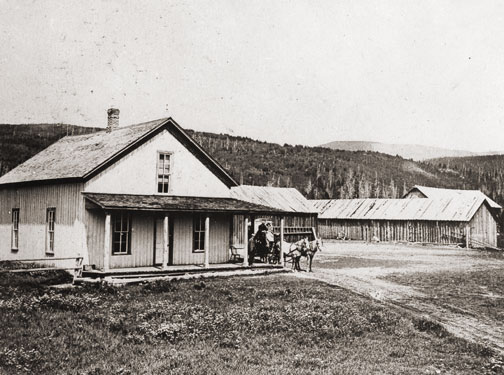
Maggie and Jimmy Crawford came to Middle Park in the summer of 1874 with their three children.

Articles to Browse

Topic: Towns

Grand Lake

Grand Lake was established in 1879 and incorporated in 1944. It is named for the largest natural body of water in Colorado. In 1867, when only a few people resided near the lake, Major John Wesley Powell (the man whose group first rafted the Grand Canyon) came to explore the possibility of floating down the Grand (now Colorado) River. That summer, Powell, local resident Jack Sumner, and William Byers, founder of the Rocky Mountain News, made the first recorded ascent of Longs Peak from Grand Lake. In the early 1900’s a Yacht Club was formed by enthusiasts who were attracted by the demands of attentive seamanship the lake demanded.

In 1912, Sir Thomas Lipton contributed an impressive cup to be presented annually to the winner of the annual August Regatta. This event still draws skilled sailors to the challenging competition. The town was founded during a very brief mining boom, but because of it's natural beauty, tourism has long been the sustaining feature of it's economy.

Topic: Towns

Tabernash

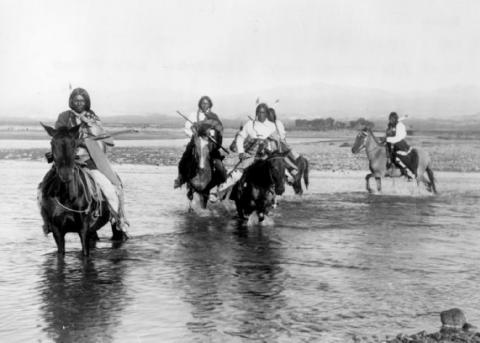
The town of Tabernash was established in 1905 on the location of the old Junction Ranch. The name came from the Ute Indian, Tabernash, who was killed here in 1878 during a confrontation with a posse sent to stop the Indians from tearing down fences and racing their horses on the white mans newly "private" property.

In 1913 the locomotive terminal was relocated from Fraser to Tabernash by the Denver and Salt Lake railroad. When the Moffat Tunnel was completed, the need for the terminal diminished, but the community persisted with a ranching economy.


Topic: Towns

Radium

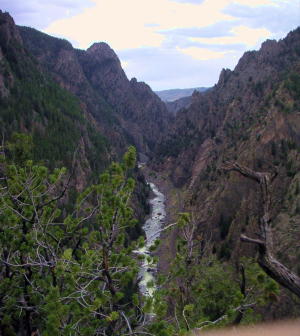
The settlement of Radium, on the north bank of the Colorado River in Gore Canyon, was established in 1906, when railroad construction of the Denver and Salt Lake Railroad brought in foreign workers, typically Swedes, Greeks, and Italians. After the rail lines were built, livestock was shipped out and vegetables such as potatoes, peas, and lettuce were grown and picked at the last minute so they could be shipped while still fresh.

Originally the land was homesteaded by the Murgrage and Hoyt ranch families. Railroad passenger service during the winter months was scheduled only three times a week each way but even then, couldn’t always get through. Nonetheless, the “Try Weakly Railroad” service was better transportation than anything residents had ever had before.

The name of Radium was suggested by Harry S. Porter because of the radioactivity found in his mine. The nearby Radium Copper Mine was a large copper producer at one time.

Maintainance workers for Union Pacific, current owners of the railroad, are still based at Radium.

Topic:

Irving Hale's Adventures in Grand County

Article contributed by Abbott Fay

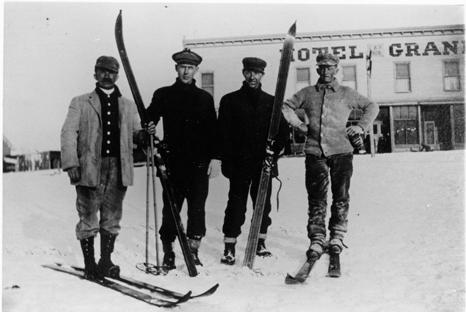
At the age of 17, Irving Hale was the first graduate of the Denver Hugh School in 1878. That summer, he and his younger brother decided to go to Grand Lake to catch trout with the plan to sell the fish in Central City and make a tidy profit.


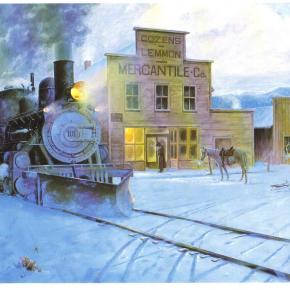
On July 5th, they camped atop of Berthoud Pass, building a "roaring fire to keep mosquitoes away".  The next day, they reached Cozens Ranch (stage stop in what is now Winter Park) but their jackass, carrying much of their supplies, had wandered off.  They feared that he had returned to Georgetown, where they had purchased him earlier in the week, but they found him grazing in a nearby pasture.


They almost drowned attempting to cross the Fraser River but finally found their way to Grand Lake on July 9th.  There, they camped and fished and collected enough trout for their return trip to Central City.  On the way back, the fish started to smell so they found some ice and started over the Continental Divide.  They realized they wouldn't make much money so were happy to sell their rotting trout for 25 cents per 10 pounds.  On July 25th they shot a deer and had a terrible time trying to skin it and cut up the meat.  Discouraged, they finally returned home to Central City.


Irving Hale was given an appointment to West Point and during his career he rose to the rank of Brigadier General. He was given command of troops in combat in the Philippines following the Spanish-American War. As Colorado's first combat general, he retired to Denver in 1906, and published his experiences as a youth in  "A Tramp Through Middle Park".


When the World War II cold weather camp was established near Leadville Colorado, it was named after Irving Hale. Many of the ski and mountaineering troops, the Tenth Mountain Division, became the founders of many of the modern ski areas of Colorado.  


Sources:

Rocky Mountain News, April 15, 1888

Sons of Colorado, Vol. I, 3&, 1906

Fay, Abbott; A History of Skiing in Colorado; Ouray, CO; 2002


Topic: Railroads

Railroads

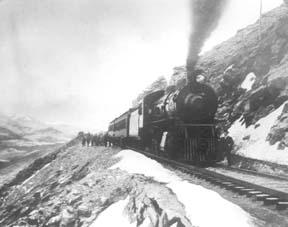
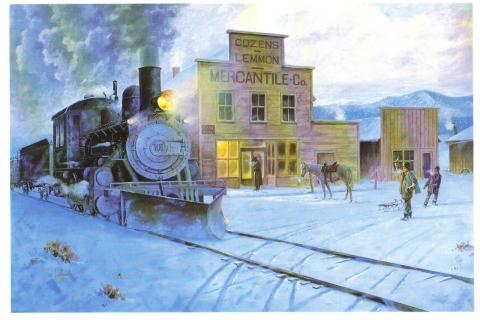
Construction on the railroad line from Denver to Grand County began in July 1902.

The project, called the Moffat road (officially the Denver, Northwestern & Pacific), was the seemingly impossible dream of David H. Moffat, who spent much of his personal fortune building the tracks over the Continental Divide.

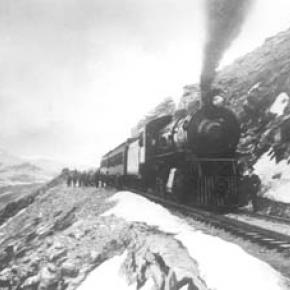
The rails pushed higher and higher up the mountains until they reached a station named Corona, meaning the crown of the continent.

Corona was the highest point in the world with a standard gauge railroad and the journey from Denver in the winter was perilous at best.

Huge snowplows were required on either side of the Divide to keep the tracks clear.

Eventually, in the late 1920s, a tunnel was dug through the range, eliminating 22.84 miles of track and the breathtaking journey over Rollins Pass.

The railroad reached Granby and Hot Sulphur Springs in 1905 and Kremmling in 1906, and played a significant role in building the population of Grand County.

In 1900 the total resident population of Grand County was only 741, but grew to 1,862 in 1910.

Topic: Water

Onahu Creek

Onahu Creek was called Fish Creek and is a tributary of the North Fork of the Colorado River. The name refers to one of the Indian race horses who came up to a campfire to warm himself, and the name means “warms himself“.  The horse ultimately died on Fish Creek and gave his name to the waterway.

Christmas at Fraser

The lights dimmed; mothers had already found their seats after coming from the classrooms where they had put makeup on little children’s faces and checked their costumes to make sure angel wings and halos were secure and costumes were on right side round.  I was at the piano, music and script lined out. The gym was full to the brim, every seat taken, with folks lining the sides and back walls, for the whole town had turned out.  Early birds got the seats!  Christmas wasn’t Christmas in the Fraser Valley unless it included the program at Fraser School (now the Town Hall).   I began the overture and chatter stopped.   I had played for this event for ages, starting in 1958.  High school students were gone by then, moved to the new Union High School in Granby, but 7th and 8th graders were still there.  And in 1958, the first kindergartens in the district were established.   It was a time of excitement and anticipation, of fun, and of panic? Well, no, not panic, for the teachers were beautifully organized. 

The program was chosen during October. Each teacher had a specific job. For instance, Martha Vernon, the art teacher, did sets.  Helen Hurtgen was responsible for dialog.  Edith Hill did costumes.  Nancy Bowlby was in charge of the music.  Others coordinated the whole.  And I played the piano, with Nancy sometimes accompanying me on her violin.  

Mothers were asked to contribute sheets and any fabric they could spare.  Patterns and material for costumes went home to be sewn into various sizes and shapes -- angels, gingerbread men, knights or royalty.  In the gym, we stitched on finishing touches, bright patches to decorate jester outfits, townspeople, and such, while watching various groups practice. Bits of tinsel became crowns, tinfoil turned into wands, cheesecloth into wings.  Lace scraps and sequins added color and “class.”   The budget was extremely minimal at first, but over the years, more money was directed to Christmas programs.  Instead of old sheets, we could buy cotton fabrics, velveteens, sometimes satin.  One year I even stopped by a furrier’s in Denver and begged some fur scraps.  Were we uptown then!  We had fur trim around the necks, cuffs, and hems of the costumes for the prince, queen, and king.  

The day before the play, PTA mothers gathered in the gym to fill brown paper sacks with an apple, orange, nuts, and candies, provided by R. L. Cogdell from his grocery store.  

Every single child in school took part in the play, as a class, except for those with speaking parts, of course.  Fraser grew and grew, then as now. Soon the 7th and 8th grades moved to Granby.  Then the 6th graders went, but the 4th and 5th graders handled the leads neatly.  Our stories were usually simple Christmas tales, but sometimes we tackled ambitious efforts such as the Nutcracker Suite or a version of Gilbert and Sullivan.   The only children not included were the Jehovah Witness youngsters.  They couldn’t be in the play and they couldn’t come watch it either.  We all felt very sorry for them, because everyone had such a wonderful time.  Their teachers tried to give them special projects to entertain and interest them while they sat off in a corner or in their classrooms.   The plays always went well.  Tiny kindergartners came out onto the stage, to stand behind the colored lights.  They knew their song perfectly in practices, but I have to admit that a number of them usually stood silent, stunned by that mass of faces looking up at them.  No matter.  They were darling. “Hi, Mom,” some were sure to call. “Mom” beamed.  

There might be a glitch or two every year. For instance, little Diane was chosen to do the Arabian dance in Nutcracker Suite.  Her parents were dark, as she was, and she was slender as a dancer. Trouble was, she didn’t have an ounce of grace in her body at that stage of her life.  I thought Nancy Bowlby was going to have grey hair before she got that child moving properly.  But the night of the program, Diane looked like Anitra herself, doing her exotic dance.   One year the king jumped his cue and entered on stage.  His first words were, “Did I miss anything?”  The prince muttered, in an aside, “Yes, three pages!”  But the cast went on as if nothing had happened, while down at the piano I sat, flipping pages rapidly, trying to figure out where the dialog was now.  

Another year, our son James was to take part in a minuet.  “Uck!  I have to touch a girl?”  By the greatest good fortune, he broke his leg and got to be a guard at the palace door, standing at attention on crutches, while another boy took his place.  (I think he did that on purpose.)   Songs and parts were adapted to the talents of the students.  We had five boys once, who couldn’t talk, dance, sing -- anything.  So they wore monks’ costumes and filed on stage, supposedly singing a Christmas carol, but supported strongly by the cast present.   Another time, Twyla’s parents couldn’t come, so Miss Vernon took her home to get ready. Now, Twyla usually looked like a dirty ragamuffin, but after a bath and hair wash, she truly looked like the angel she portrayed.   For the finale, the entire school came on stage to sing a last carol, with the audience joining in.  Then Santa showed up to distribute the goodie sacks, and the great night was over.  Coming out into the quiet night was a wonderful feeling.  Sometimes we moved through drifts of new falling snow; sometimes the sky was filled with icy stars.  Gay lights showed in windows throughout town. 

We never talked much on the way home, as we thought of the play, the success of everyone¹s efforts, and how happy the children had made their parents and families.   My last program was the first year after the new school was built.  It was fun still, but the school population had grown enough that it was impossible for whole classes to participate as one. Things weren’t the same as they were in the little old school.

Topic:

Regions

Grand County has a stunning variety of terrain, landscapes and distinctive regions.  The county encompasses 1869 square miles with almost 68% of the land is managed by the U.S. Forest Service, the Bureau of Land Management or the National Park Service. The Continental Divide marks the northern and western boundary of the county and the county is also the headwaters of the Colorado River.  Regions have been established by proximity to water sources (The Troublesome, The Muddy, The Blue, and Three Lakes) or by their geographic features (Middle Park, Church Park, and the Fraser Valley).

Topic: Ranching

The Davison Ranch

* Copyright 2006.
No portion of this story or photos may be reproduced without the written permission of Gary or Sue Hodgson (www.hodsonmedia.com)  

Early morning, mid January in Colorado's Middle Park is not for the faint of heart. It's forty below zero. Six inches of new snow have fallen over night, adding to the three feet that have been building since early November. Ranchers in the area don't even bother to look at the breath taking beauty of the Gore Range to the West as they trudge to the barn. Their minds are focused on hope the big diesel tractors will start. Snow has to be moved and cattle fed. Life in these parts revolves around "feeding". Soon, ranch yards will be full of diesel engines belching black smoke clouds. Up and down U.S. Highway 40, this scene is repeated on ranch after ranch ... except for one. 

Just south of mile marker 169, a landmark rendered meaningless by snow much taller than the signpost, sets the Davison Ranch. Several hundred cattle wait semi-patiently to be fed in the surrounding meadows, yet there are no black smoke clouds or clattering engines. One might think the ranch deserted were it not for muffled sounds creeping through the huge log walls of the old tin roofed barn. Inside, a crew of five are performing a morning ritual that began in late November and will be repeated, regardless of the weather, seven days a week until mid May.  Mark, Molly, Dolly, Nip and Tuck are getting ready to feed.  

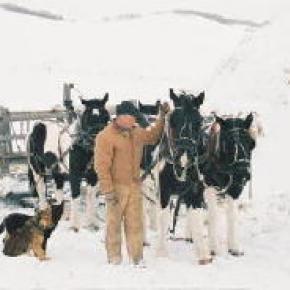
A crew this small is rather unusual for a ranch that encompasses over 6,000 acres. More notable, only one member is a man. The other four are horses, big, stout, work hardened draft horses. Standing on the wooden planked floor, side by side, surrounded by logs a man could hardly put his arms around, are four beautiful black and white Spotted Draft Horses. While not rare, the National Spotted Draft Horse Association celebrated it's tenth anniversary in 2005, the spotted giants are not a common sight. It is fitting such unusual horses would be found on this ranch. The big black and whites fit right into a program in place nearly fifty years. Mark Davison relates the Davison Ranch history as he harnesses the big "Spots." 

Mark's father, Charles Edward "Tommy" Davison, had been saving to buy a ranch since he was six years old. When the old place north of Kremmling came up for sale, the young bachelor fulfilled his life long dream. Tommy made a few observations. The ranch did not produce gasoline for the old tractors that came with the ranch. It did grow grass to power the two long ignored draft horses, also included. Then, there was the snow to deal with. It seemed easier for horses to pull a sled full of hay on top of the snow than trying to drive a tractor through it. The ranch was strewn with old harness and equipment including an ancient hay sled and various hitch components. He was single with an old house to spend the winter nights in. Why not spend a little more time outside with the animals he so loved.  

Not all of Tommy's plans went according to schedule. The hay laddened sled required more horsepower than his two horses. Two more "kinda" draft horses joined them. The old log house burned to the ground in December that first year. Hurriedly, he built a small cabin to live in until another house could be constructed. In 1958 he met and married Laurayne Brown. The Kremmling native beauty was used to the harsh winters and loved the big horses. Tommy and Laurayne made as good a team as Nip and Beauty, one of the better teams they would own in those days. As the ranch grew they realized they needed more help. New Year's Day 1960 they interviewed a likely prospect. Jerry Nauta sat at the Davison kitchen table as they talked. Finally, he uttered memorable words. "If you treat me right," he said, "I will never leave this ranch." Addressing Laurayne he went on, "I will probably eat more meals at this dinner table than you will." 

Although the ranch owned several tractors as much work as possible was done with the horses. The ranch's hay crop, wonderful sweet smelling Meadow Brome, Timothy and Red Top was put into giant loose hay stacks. No need for big gas guzzling tractors pulling expensive balers on this ranch. A few other ranches also kept draft horses in those days. A big attraction at Kremmling's Middle Park Fair was the draft horse pull. Ranchers from neighboring North Park descended on the event with their horses, toughened by a summer of harvesting the Park's huge hay meadows. Most years they returned to their home valley with the Middle Park trophy. Tommy decided enough was enough. Even though he had never competed before, his team of the skittish Nip and gentle Beauty who scarcely knew a day out of harness, left the "invaders from the north" in their dust. The trio returned several more years, winning every single time. Finally, a bad referee's call moved another team into first place. Tommy, Nip and Beauty never entered again. It wasn't necessary. They had proven their point. 

During those years, money would sometimes be so tight the loyal employee Jerry couldn't be paid. Tommy would sign a promissory note to him for wages. He was always repaid, with interest. Tommy told friends, "Jerry is my banker!" Jerry became a third parent to the three boys born to Tommy and Laurayne, Matt, Mark and Cal. They joined the early morning harnessing ritual, standing on a milk stool to reach the big horses under this watchful eye. When their father suffered a broken leg followed by a ruptured appendix, the boys, averaging ten years old, stepped into rolls as hired men. They calved cows, lambed the ewes in residence on the ranch in those years and, of course, harnessed and drove the teams to feed. If harnessing and driving a four horse hitch wasn't enough of a challenge, the feeding process creates men as tough as the animals pulling the heavy sled. Up to three tons of long stemmed loose hay have to be pitched onto the sled. Once the feed grounds were reached, every single blade is forked onto the ground as the patient team slowly moves ahead of the hungry cattle. Most days three or more loads were required to complete the task.           

Tommy Davison fell ill in 2000. Mark who had remained involved in ranch operations while establishing another ranch in Wyoming, returned to the Kremmling ranch full time to oversee operations there. When Charles Edward Davison passed away in 2001, Mark leased the ranch from his family. Just as his father had done nearly fifty years ago, Mark took stock of what he had to work with. The harness, some nearly 100 years old purchased here and there over the years was in pretty good shape. The horses, however, had grown too old to be worked every day. He needed two more to complete his four horse hitch. Harley Troyer?s well known Colorado Draft Horse and Equipment Auction was coming up in Brighton, Colorado. Mark traveled to the "flat lands" and returned with two roan Belgium geldings. Sadly, one died within a year. He tried a "unicorn hitch" placing a single lead in front of the wheel team. It was not practical for the loads and trails they encountered. Mark headed back to Troyer's Auction once again. A novelty of the upcoming event was a pair of black and white Spotted Draft horses originating from Canada. When he arrived at the auction Davison found not two, but four of the Spots, two geldings and two mares. All were only two years old. To most, the big youngsters would need years of seasoning before they would be dependable. A lifetime spent around draft horses gave Mark Davison a different view.. He noticed how much time previous owners seemed to have spent with them. It showed in their responsiveness and manners. Auction owner Troyer remembers them as "A nice four up." When his gavel fell, all four were headed to Kremmling.

Today, as nearly every day of the year, the wheel team of Nip on the left and Tuck to the right of the wooden tongue, follow the lead team of Molly and Dolly, left and right respectively. They begin pulling when Mark softly commands "gitup" and stop when told to "whoa-a." Armed with an antique True Temper three tine pitch fork (this model is no longer made according to Mark) he hardly notices their direction as he pitches hay to the trailing cattle. The scene is spell binding to anyone fortunate enough to see it. Soft commands, creaking leather and steel clad wooden sled runners gliding over the snow summon long forgotten instincts. 

Though Mark describes himself as a "Dinosaur," all that happens on the Davison Ranch is part of a plan that arose from necessity. He points out that when hitched to the sled, only the wheel team is attached to the tongue. The lead team's evener, an antique itself, is attached to a log chain r nning back to the front of the sled, not attached to the tongue in anyway.  Tight corners the team must navigate winding into the mountains to feed the cow herd make a conventional arrangement dangerous. If the wheel team follows the lead teams tracks too closely, the sled would cut the corner and plunge off the precarious road. The loose chain arrangement allows both sets of horses freedom to follow their own path. The horses, sensing their safety as the reason for the odd arrangement, work quietly beside the chain. If one happens to step over it, the next step will be back into place without so much as a twitch of an ear.  

Feeding begins around 8:00 a.m. The teams are usually back in their stalls eating "lunch" by 2:00 p.m.  Six hours, eight tons of hay and nearly ten miles every single day make the horses tough and strong. They symbolize the word that describes life on the Davison Ranch. Harmony. The horses work in harmony with each other and their care taker. Horses and man work in harmony with nature. There is a strong respect for tradition on the Davison Ranch. The old ways made sense then and now. There is no need for electric engine heaters or big diesel engines on this ranch. The beautiful black and white horses seem to be thankful for the chance to live the life for which they were bred. They express their gratitude with loyalty to Mark Davison.  

Loyalty might also be used to describe the Davison Ranch business plan. Remember Jerry Nauta's pledge to never leave the ranch if they treated him right?  Jerry lived in the small cabin Tommy Davison built when the ranch house burned down from January 1, 1960 until a few months before his death in July 2005. He was 92 years old.

Life is different on the Davison Ranch. Old fashioned values reign amidst modern Spotted versions of man's first and perhaps best machinery, the draft horse. Men and horses are a lot alike, you know. Treat 'em right and they'll reward you with loyalty.
Topic: Grand County

Grand County Trivia

After 1879 there were no Native Americans in Grand County.

In the 1800, the leading cause of death in Grand County was accidents followed by pneumonia.

Between 1887 and 1902, Grand County had no divorces.

The total resident population of Grand County in 1900 was 741.  The average life expectancy was 47 years.

Winters in Grand County often were severe, but nothing as terrible as the winter of 1898-1899.  Warm weather preceded the storm which began on February 2nd.  Four feet of snow fell by that first evening and the residents did not see the sun for the rest of the month as the snow continued to fall.  The snow continued into March and April and while few residents died, but the loss of livestock was tremendous.

Crawford